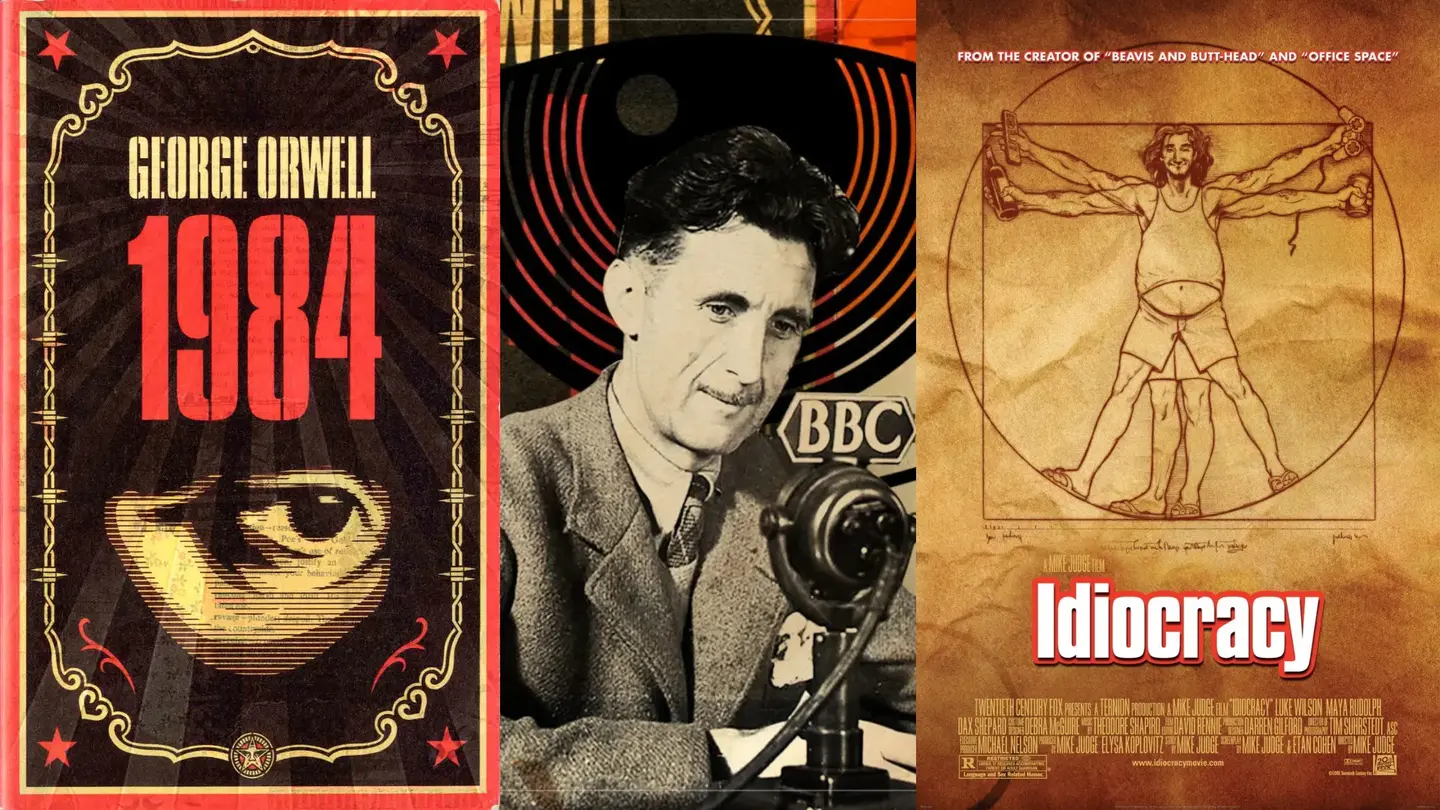
What happens when a government gains control over what people think, what they believe, what they remember, and even what they are allowed to say?
And what happens when people gradually lose the ability to think for themselves, question things, or distinguish what is meaningful from what is simply entertaining?
George Orwell's 1984 Book and Mike Judge's Idiocracy film imagine two very different dystopian futures. One is a world where the government controls almost every aspect of human life, including people's thoughts. the famous slogans of the Party are "War is Peace, Freedom is Slavery, Ignorance is Strength." It is a world where even thinking differently from the government is a crime. People live under constant surveillance, history is rewritten to suit the Party, and hatred is deliberately directed towards enemies to keep the population loyal. The government doesn't just want obedience; it wants complete control over the human mind.
The other is a world where people have become so intellectually disconnected that they can barely think, read, reason, or have a meaningful conversation. It imagines a future where intelligence and education have gradually lost their value. Entertainment has replaced curiosity, advertising has replaced independent judgment, and even the government has become a comedy show. People are not being forced to stop thinking. They have simply reached a point where thinking itself seems unnecessary.
What makes these two worlds so interesting is that neither imagines the future as a civilization destroyed by nuclear war, an alien invasion, or some catastrophic disaster. Instead, they explore something much more uncomfortable: what happens when a society slowly loses the very qualities that make it capable of functioning? Thinking!
I recently watched Idiocracy again. With the film being discussed so much lately and its relevance to today's world becoming increasingly difficult to ignore, I found myself thinking about it alongside of my favorite book 1984. Of course, our world is not Oceania, and we haven't become the people of Idiocracy. But we don't have to for the warning to matter. We can already see pieces of both in an ordinary day.
Look around us. We have governments and powerful institutions capable of influencing what information reaches us. We have technology that constantly observes our behavior, algorithms that decide what we see, and an entertainment culture that competes for every moment of our attention. At the same time, we are surrounded by more information than any generation before us, yet finding the time and willingness to question, understand, and think deeply about it seems increasingly difficult.
One imagines a world where people are not allowed to think. The other imagines a world where people no longer want to.
Thinking? The First Thing a Society Can Lose
Winston Smith has a small corner in his flat.
There's one spot in the room the telescreen can't see, the device in every room that watches and listens and can never be fully switched off. He sits there with a pen and a diary he isn’t supposed to own, and he starts writing. Nothing dangerous, just whatever is in his head.
And that is already the crime. In Oceania nobody needs to catch you with a weapon or a plan. Thinking the wrong thing is enough. Winston knows it as he writes, and he writes anyway.
I think this is where 1984 is at its best, before it gets to surveillance, propaganda, or torture. Orwell starts with the smallest possible act of rebellion: an ordinary man, in a corner, trying to think. Winston isn’t a hero or a revolutionary. He works at the Ministry of Truth, quietly rewriting old newspapers so the Party is never wrong. What separates him from everyone around him is the one thing the whole system is built to remove. He notices.
Look at how the Party goes after it. It builds a language called Newspeak, and a man named Syme, who works on the dictionary, is almost cheerful about it. The goal is to make the language smaller every year. Fewer words mean fewer thoughts, and eventually you can’t even form the idea of rebelling, because you have no word for it. It’s one of the most chilling ideas in the book, partly because it makes sense. If I can’t say it, can I still think it? Then comes the Two Minutes Hate, where the crowd screams at a face on the screen until the anger takes over, and even Winston, who knows exactly what is being done to him, feels it pulling him in.
This is what makes the book 1984 so powerful. Before showing us how a government controls information, rewrites history, watches its citizens, and manufactures hatred, Orwell explores something much deeper: what happens when a person loses the freedom to think independently?
And yet Winston continues to think, even when he knows that doing so could destroy him.
Now go five hundred years into the future, to a different kind of dystopia.
Idiocracy opens with a short joke about evolution. Smart, careful people keep putting off having children until the timing is right. Everyone else doesn’t wait. A few generations later, nobody is left who reads. The movie uses this exaggerated contrast to introduce its satirical idea of how society eventually evolves.
Five hundred years later, Joe Bauers, an ordinary American soldier selected for a military hibernation experiment because of his remarkable averageness, wakes up in the year 2505. The experiment has gone wrong, and he has been forgotten for centuries. What he discovers is a civilization where intelligence, education, and even basic reasoning have become incredibly rare.
People struggle to read, understand simple instructions, and have serious conversations. Entertainment has taken over almost every aspect of life. Corporations dominate society, advertisements influence everyday decisions, and even the government seems incapable of dealing with basic problems.
Here nothing is taken from anyone. There’s no telescreen, no Party, nobody punished for a thought. The only people who ever try to stop Joe are the ones he’s trying to help. He asks a simple question or tries to reason something out, and they laugh at him. Why would he want to talk like that? It’s just a joke to them. The most popular show on television is a man getting hit in the groin, repeatedly, and the whole country laughs every time. Nobody forbids the serious conversation. People just can’t be bothered to have one. They are free to question, learn, read, and explore. But they have gradually reached a point where they neither value nor seem interested in doing any of those things.
The very things that make Joe an ordinary person in our present world make him seem extraordinarily intelligent in theirs. It takes something we consider basic and places it in a world where it has become exceptional.
Think about the difference between these two worlds. In Oceania, Winston is punished for thinking differently. In the world of Idiocracy, Joe is ridiculed for thinking differently. One society actively suppresses intelligence, while the other has gradually stopped valuing it.
Both eventually arrive at a similar place: a society where independent thinking becomes increasingly uncommon.
What makes these ideas particularly interesting when looking at our present world is that thinking is not just about having an opinion or knowing something. It requires effort. It means questioning what we hear, exploring ideas we don't necessarily agree with, reading something that challenges our existing beliefs, and sometimes accepting that what we previously believed was wrong.
And I think this is something we are slowly losing sight of.
We have more access to information than any generation before us. Almost any subject can be explored within seconds. We can read books, watch lectures, learn new skills, listen to different perspectives, and understand events happening on the other side of the world. Yet having access to information and actually making an effort to understand it are two very different things.
Look at how much of our everyday time is spent consuming content. We scroll through endless videos, seeing not meaningful content, read headlines without opening articles, watch people argue about complicated subjects in a few seconds, and form opinions based on fragments of information. Sometimes we don't even remember what we watched a few minutes earlier. We simply move on to the next thing.
There is nothing wrong with entertainment. I enjoy movies, comedy, and spending time watching things just for fun. The problem begins when entertainment becomes almost our entire relationship with information, when we no longer have the patience to read something in depth, follow an argument, or spend time understanding an issue.
Reading a book requires attention. Having a meaningful conversation requires listening. Understanding a complicated subject requires patience. Thinking about an idea requires sitting with it rather than immediately moving to the next distraction.
These things don't always provide instant gratification, and perhaps that is exactly why they are becoming easier to neglect.
I sometimes think about how different our conversations have become. Remember when meeting a friend meant spending hours discussing something, sharing ideas, talking about life, or even arguing about something you disagreed on? Now, so much of what we share is simply a reel, a funny video, or something that caught our attention for a few seconds. There is nothing inherently wrong with that, but I wonder how often we actually make time for conversations that challenge us or make us think.
This is where I find the two works particularly relevant. Orwell imagined a system that would eliminate independent thought because it understood how dangerous it could be to those in power. Mike Judge imagined a culture where people would gradually abandon intellectual curiosity because entertainment and instant gratification had become more appealing.
A society that doesn't make an effort to think becomes easier to influence. When people don't question what they read, watch, or hear, someone else can increasingly shape their understanding of the world. It doesn't always require force, censorship, or an obvious attempt at manipulation. Sometimes it is enough to keep people distracted, feed them what they already want to hear, and make sure they never feel the need to look beyond it.
In the book 1984, Winston's ability to think independently is the beginning of his awareness that something is deeply wrong with the world around him. In Idiocracy, Joe's ability to think makes him stand out in a society that has forgotten the value of thinking altogether.
Both remind us that independent thought is not something we should take for granted. It is what allows us to question, understand, disagree, learn, and make our own decisions.
Perhaps the greatest danger is not a world where someone tells us what to think, but one where we gradually stop making the effort to think for ourselves.
Awareness and Ignorance: When the Obvious Becomes Invisible
In the book 1984, Winston doesn't begin as a revolutionary or someone who fully understands the system he lives in. He is an ordinary man working at the Ministry of Truth, following the same routine as everyone else. But there is something different about him. He notices things. He remembers fragments of the past, recognizes contradictions in what the Party says, and begins questioning the reality presented to him.
One of the interesting aspects of Winston's character is that he doesn't have all the answers. He doesn't know the complete history of Oceania or exactly how the Party operates. He is uncertain about many things. Yet he doesn't ignore the questions that come to his mind. He starts writing a diary, tries to understand the past, and eventually looks for someone with whom he can share his thoughts.
There’s a scene in 1984 that I find more disturbing than any torture room.
It’s Hate Week, and the whole city is packed into a square. A speaker is screaming about the enemy, Eurasia, the country Oceania has always been at war with. Posters cover the walls and the crowd is shaking with anger. Then a piece of paper is quietly handed to the man on stage, and without missing a beat he changes one word. The enemy is now Eastasia. It was always Eastasia, and Oceania has always been at war with Eastasia.
The crowd doesn’t hesitate. People who were screaming at one enemy a moment ago scream at another, and some run to tear down the old posters as if they’d never believed in them.
Winston is standing in that crowd, and the thing he notices is that nobody else has noticed.
What I find most disturbing about this scene is how effortlessly the Party changes reality in front of everyone. Nobody questions the contradiction, nobody wonders what happened to the previous enemy, and nobody seems to remember what they were shouting about just moments ago. The Party doesn't even have to convince them with a new explanation. It simply changes the narrative, and the people follow.
Winston, who is witnessing all this, understands something that the others seem to have completely forgotten: if the past can be changed so easily, then what is stopping the Party from changing anything it wants? What makes this even more frightening is that the people aren't necessarily unaware of what they just witnessed. They simply accept it and move on. It shows how completely the Party has taken control, not just over information, but over people's relationship with reality itself.
“Until they become conscious they will never rebel, and until after they have rebelled they cannot become conscious.”
Now consider Joe in Idiocracy. When he wakes up 500 years into the future, he immediately notices how absurd the world has become. But the people living there don't see it that way. They have grown up in that environment, and everything around them has become normal. Even mountains of garbage in the city are normal.
One of the best examples is the Brawndo scene. Joe discovers that people are using an energy drink called Brawndo instead of water, even for watering crops. The crops are dying, and when Joe suggests using water, nobody understands why he would want to replace Brawndo with something that doesn't have what plants crave.
The scene becomes even more amusing when Joe tries to explain that water is what plants actually need. The people are so convinced by the product's advertising that even a basic scientific explanation sounds ridiculous to them. The government, corporations, and ordinary people are all part of the same absurd belief system.
What makes this scene so brilliant is that nobody in the movie thinks they are doing anything wrong. They aren't deliberately destroying their agriculture. They genuinely believe they are doing the right thing.
And that is perhaps more frightening than if they knew what they were doing.
In Oceania, people are given a manufactured version of reality and expected to believe it. In Idiocracy, people have become so disconnected from reality that they cannot recognize when something is obviously wrong. Winston notices the contradictions but lives in a world where he cannot openly question them. Joe openly questions everything but lives in a world where almost nobody understands his questions.
Another movie that comes to mind here is Pixar's WALL-E.
In it, Earth has become so buried in garbage that humans left long ago and now live on a giant spaceship called the Axiom. Robots do everything for them. They glide around in floating chairs with a screen in front of their faces and spend almost all their time-consuming entertainment. Nobody has to try at anything.
There is a small but memorable scene when John accidentally falls out of his floating chair. Until that moment, his attention has been occupied by the screen in front of him. But once he falls, he starts looking around. He notices his surroundings, discovers things he had never paid attention to, and even begins interacting with another human being.
It is such a simple scene, yet it says a lot. John didn't suddenly become a different person. He simply got an opportunity to notice the world outside the screen.
I sometimes think about this when I see how we use our phones. Even a few moments of silence are often filled by opening an app or scrolling through something. We have become so accustomed to having something constantly occupying our attention that sitting alone without a screen can feel unusual.
But I wouldn't simply blame the people for this. The humans aboard the Axiom didn't suddenly decide to live that way. Their entire civilization had been built around convenience and consumption. Similarly, our technology and entertainment systems have developed in ways that constantly compete for our attention.
The interesting question is how much of this behavior we actually notice while participating in it.
Winston's story is about a man who begins noticing things that everyone around him is expected to ignore. Joe's story is about a man who notices things that everyone around him has stopped recognizing as problems. And John's little moment in WALL-E shows how easily we can become disconnected from the world when our attention is occupied elsewhere.
Perhaps the most uncomfortable similarity is that none of these characters begins with some extraordinary ability. They simply start noticing what is happening around them.
And sometimes, that is where the biggest difference begins.
Surveillance, Power and Control: The Power to Rewrite Reality
There is a small hole in the wall next to Winston’s desk.
Every day slips of paper come to him with instructions: an old newspaper article to fix, a prediction that didn’t come true, a name that is no longer safe to mention. His job is to rewrite them, so the Party was right all along. The old version goes into the hole, the memory hole, and is burned. By evening the archive says what it should have said. There is no correction and no apology. It was always that way.
Once, when a man had to be erased, Winston didn’t just delete him. He invented a replacement, a war hero named Comrade Ogilvy who had never existed and gave him a biography. Nobody checked. A made-up man was now part of history.
Who controls the past controls the future: who controls the present controls the past.
This is the part of the Party's control I find most frightening, because it is aimed at thinking itself. Think about how you know anything. You compare. Yesterday with today, what you were told with what actually happened. Memory and records are what we measure the present against. Now take them away. Ogilvy never lived, yet he is in the archive, and anyone who remembers it differently has no newspaper to point to and nobody to back them up. The Party doesn't have to argue with you. It only has to remove whatever you would argue with. And slowly, even your own memory starts to feel like the unreliable one. Was it really different before, or did I imagine it?
If some doubt still survives, there is one last step, called doublethink: knowing something is false and believing it anyway. Two plus two is four, and two plus two is five, and you hold both without feeling the contradiction. The Party isn't asking you to lie. It's asking you to actually believe. At that point nobody has to silence your thinking. You do it yourself, from the inside.
One of the most frightening things about the world in the book 1984 is that there is practically no private space. The Party doesn't just control public life; it wants to know what people do, what they say, and even what they might be thinking.
Everywhere Winston goes, there are posters with Big Brother's face and the words "BIG BROTHER IS WATCHING YOU." Telescreens are installed in homes and public places. They broadcast Party messages, but they also allow the government to observe people. The Thought Police are always a possibility, and nobody knows exactly when they might be watching.
Even inside his own apartment, Winston cannot be certain that he is alone. He has to be careful about his expressions, movements, and conversations. A moment of carelessness could reveal something the Party considers suspicious.
What makes this particularly disturbing is that people don't even need to be watched every second for surveillance to work. The uncertainty itself is enough. When you know that you might be watched at any moment, you begin controlling your own behavior. You become careful about what you say, what you express, and even what appears on your face.
The Party has created an environment where people monitor themselves. But surveillance is only one part of its control. The Party also wants to decide what people believe.
One of the most memorable examples is the Two Minutes Hate. Every day, people gather in front of a screen and watch a broadcast designed to generate hatred towards Emmanuel Goldstein, the supposed enemy of the Party. The crowd becomes increasingly angry, shouting and expressing hatred together. It is almost as if individual thought disappears into collective emotion.
The interesting part is that the Party doesn't simply ask people to be loyal. It continuously creates an enemy for them to hate. Their anger needs somewhere to go, and the Party provides a target.
Even more disturbing is how quickly these emotions can be directed. People don't need to understand the political situation or examine the reasons behind their hatred. They simply need to participate.
Our smartphones are not telescreens, and I don’t want to pretend they are. The same phone lets me read almost anything, talk to anyone in the world, and say things that nobody would ever have heard in Oceania. But it also keeps a record. Where I go, what I buy, what I linger on, what makes me react: all of it adds up to a portrait most people would never hand over on purpose. Platforms learn what holds our attention and feed us more of it, and most of the time we can’t say why a particular post or video showed up. So, the question isn’t really whether something is watching. It’s who gets to use what it learns about us, and for what.
The Ministry of Truth shows up in our world in a looser form. Winston had a whole department rewriting history. We have photos that can be edited, videos that can be generated, voices that can be cloned, and a made-up story that can reach millions of screens before anyone has checked it. Nobody is deliberately rewriting the past, and I don’t think every algorithm is trying to control our minds. But the result is that checking what’s true, finding where it came from, and noticing when we’re being pushed have become part of everyday life. The Party understood something simple: whoever controls what people see, remember, and believe holds enormous power. That power exists today. What matters is who holds it, and how aware we are that it’s there.
This is where Orwell's ideas become particularly powerful. Controlling people doesn't always mean physically restricting their movements. Sometimes it means controlling the information available to them, shaping their emotions, and gradually removing their ability to distinguish truth from what they are being told.
The Broken System: When the Government Becomes a Comedy Show
In Idiocracy, the president arrives like a wrestler walking into a ring. He is a former pro wrestler, and the speech is part rally, part stage show, with noise, lights, and a crowd that cheers before he has said anything. He is loud and confident, and the country loves him for it.
Then the show ends, and the actual problem is still there. The crops are dying, the food supply is failing, and Joe, the only person who seems to understand why, is given a week to fix it.
Camacho is not presented as a leader because of his knowledge, experience, or ability to solve problems. He is presented as a leader because he knows how to put on a show. The people love him, and that seems to be enough.
I find this particularly interesting when looking at how politics and public life increasingly operate around attention. A leader's ability to dominate headlines, create viral moments, entertain audiences, and provoke reactions can sometimes receive more attention than their actual decisions or understanding of complicated issues.
What I find more telling than the president is who he listens to. The company behind Brawndo has bought its way into the agencies that are supposed to regulate it, so nobody in the system has a reason to say the drink is the problem. You’ve seen the scene where Joe says the plants need water. The more important scene is what happens when he’s right. The company’s stock collapses, jobs vanish, and people blame Joe. The people who stood to gain from the lie were running the country, and the people who paid for it had no seat at the table.
I think this is the part of the film that ages best. The president is funny, but the president isn’t the real power. Whoever owns the thing everyone depends on is.
The problem is not simply that corporations exist or that people consume products. It is that the interests of businesses have become so deeply connected to the functioning of society that nobody seems to question whether those interests are serving the public.
This also makes me think about some of the problems we are facing today. Technology companies, governments, and industries are increasingly connected, and decisions made by a handful of powerful organizations can have consequences for millions of people.
I can’t read that scene without thinking about how we handle our own problems. We have an industrial pollution problem, then a climate problem, a plastic and waste problem, and then privacy and surveillance laws that were supposed to catch up with the internet. Each one gets loud for a while. Then a new one arrives, and we move on to talking about that. Hardly anyone asks whether the last one was solved. It wasn’t. It just became normal, like the garbage. Now the loud problem is AI, and the earlier ones sit quietly in the background, still unfixed.
That is perhaps one of the most uncomfortable aspects of Idiocracy. Its civilization hasn't collapsed because of one extraordinary disaster. It has deteriorated through years of poor decisions, misplaced priorities, and problems that nobody took seriously enough to address.
Brawndo wasn’t a bad idea at first. It was a product, and no one stopped it from becoming the only thing left standing. The mountain of garbage in that film didn’t appear overnight. It grew a little every day while everyone was busy consuming content.
So, Are We Somewhere Between Orwell’s 1984 and Idiocracy?
In the end, the system breaks Winston. He is made to say that two plus two makes five, and then he’s made to believe it, like everyone else. He still notices things, but he no longer lets himself act on them. The thing that set him apart in the first place, the thing he did in a corner with a diary, is the thing that destroyed him. Thinking.
What makes Winston's ending, so disturbing is that he was never really trying to change the world or lead a rebellion. He wasn't some great revolutionary with a plan to overthrow the Party. He was an ordinary man who wanted something much simpler. He wanted to understand the world around him, remember things as they happened, have his own thoughts, and live without constantly worrying about whether someone was watching him.
He wanted to save himself: to not get trapped, to not be manipulated, to keep control of his own mind. He wanted to be able to notice something wrong without having to pretend that everything was right.
But even that was too much for the system. His curiosity, his awareness, and his desire to think independently eventually became the very things that led to his destruction. The Party didn't just want him to obey. It wanted him to genuinely believe. And by the end, it had achieved exactly that.
I think this is what makes Orwell's warning in 1984 so powerful. What happens when a system becomes so powerful that it doesn't simply control what people do, but also determines what they are allowed to believe, remember, and think? And what happens to an individual when even the ability to recognize the truth can become dangerous?
Idiocracy ends differently, and I think that’s the part people forget. It isn’t a dark ending.
The same people who laughed at Joe and mocked him for speaking seriously and couldn't understand why he kept asking questions. His ability to read, reason, and explain things made him seem strange in a society where those abilities had almost disappeared. once they see that he can solve something they can’t. They listen and they follow. Joe doesn’t fix everything. The garbage, the companies running the government, and all the other problems don’t disappear. But nothing in that world was stopping them from changing. There was no Party, no telescreen, and nobody punished for a thought. The people who gave their lives to shows and quick laughs were still able to turn around and listen. It was only a little, but they did.
And that is an interesting difference between the two films.
Winston lives in a system that cannot tolerate someone thinking differently. Joe lives in a society that has largely forgotten how to think, but when someone finally demonstrates the value of it, people are still capable of listening.
Joe's speech towards the end brings this idea together. He reminds people that there was a time when intelligence was respected, when people-built ships and pyramids, went to the moon, people read, wrote books, and made movies with stories worth caring about. He doesn't describe some perfect civilization. He simply reminds them that society was once capable of doing things that now seem almost unimaginable to them.
And then he says he believes that time can come again.
I like that ending because, despite everything the film has shown us, it doesn't leave us with complete hopelessness. The people haven't suddenly become intelligent, and Joe hasn't solved every problem. But perhaps they have started to recognize that something has been missing.
The film ends with the possibility that things can change, even if nobody knows exactly how long it will take.
And that brings me back to our own world.
I sometimes wonder which of these two endings we should be more concerned about. Winston's, where someone who notices, questions, and thinks independently is eventually broken by a system that demands complete obedience? Or Joe's, where people gradually lose interest in thinking, until the ability to reason becomes something extraordinary?
I don't know whether we are moving towards either of these fictional worlds. Perhaps hopefully we will never get there. But when I think about the problems we've discussed, from surveillance and manipulation to entertainment, corporate influence, and the gradual acceptance of things that should probably concern us, I find it difficult not to see some uncomfortable similarities.
And perhaps that is why I find Joe's final speech and Winston's final moments so interesting when considered together.
One reminds us of what happens when a person loses the freedom to think. The other shows what happens when a society gradually loses its interest in doing so.
But Joe still believes things can change. Winston, by the end, doesn't even remember that they ever needed to.
I suppose that leaves me with one question.
If Winston were sitting among us today, would he still notice the things he once noticed? And if Joe suddenly woke up in our world, would he find people willing to listen to him, or would he simply become another person trying to get our attention?
"Anyway, that's enough thinking for today. Keep scrolling and have fun."
Comments
No comments yet. Be the first to share your thoughts.