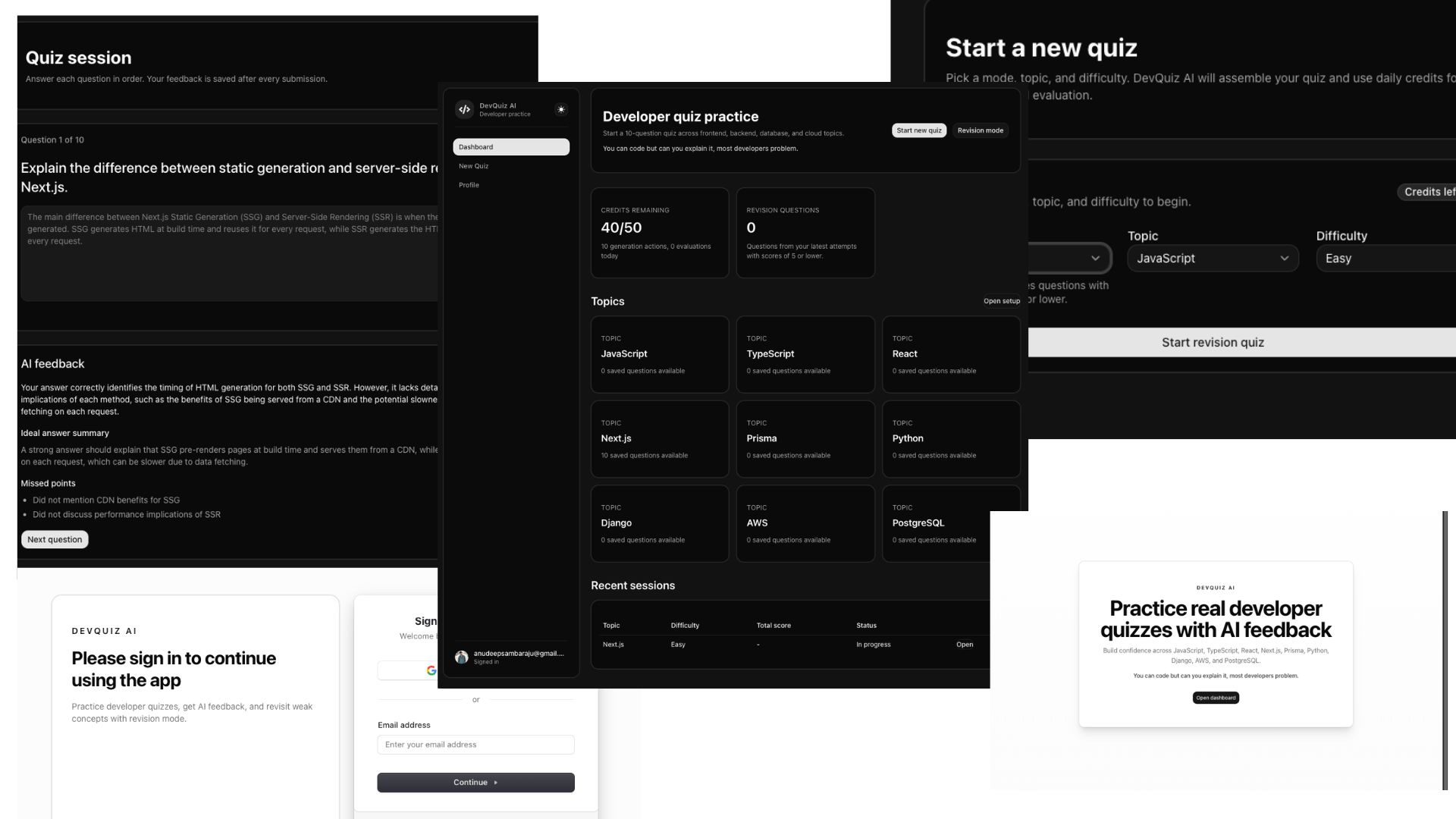
Live: dev-quiz-ai.vercel.app
After building full-stack apps like blogging platforms and content systems, I wanted to explore something deeper:
Not just building features —
but building something that improves how developers think and explain.
That’s how DevQuiz AI started.
1. The Problem I Noticed
Most developers can write code.
But when it comes to:
- explaining concepts clearly
- breaking down logic
- reasoning through problems
- answering interview-style questions
there’s a gap.
And that gap shows up exactly where it matters —
interviews, discussions, and real-world problem solving.
So I asked:
What if practice wasn’t about writing code…
but about explaining it?
2. What DevQuiz AI Does
DevQuiz AI is a full-stack AI-powered quiz platform where developers can:
- take topic-based quizzes (JavaScript, React, Next.js, Prisma, etc.)
- answer in free-text (not MCQs)
- receive AI-evaluated feedback
- get a score out of 10
- see missed points and ideal answers
- revisit weak areas through revision mode
It’s not a quiz app.
It’s a thinking + explanation training system.
3. Core Idea
“You can code. But can you explain it?”
That’s the entire product.
4. Why I Built This
Most AI apps today are:
- generic chat interfaces
- prompt → response tools
- demos without structure
I didn’t want to build another chatbot.
I wanted to build something that:
- has a clear purpose
- uses AI in a controlled way
- feels like a real product
- solves a specific developer problem
5. Key Features
- AI-Generated Quiz Questions
- Questions are generated based on:
- topic
- difficulty
- type (theory, debugging, scenario, etc.)
- Reuses stored questions when possible
- Generates new ones only when needed
This avoids unnecessary AI calls and builds a reusable question system.
- Free-Text Answer Evaluation
Instead of MCQs:
- users write real answers
- AI evaluates them using structured output
Each answer returns:
- score (out of 10)
- feedback
- ideal answer summary
- missed points
This mimics real interview evaluation, not guessing options.
- Revision Mode (Most Important Feature)
This is where the product becomes useful.
- questions with low scores (<= 5) are saved
- revision mode reuses those weak questions
- users improve on the same concepts
This turns the app into a learning loop, not a one-time quiz.
- Daily Credit System
AI usage is controlled through:
- daily credits
- generation cost
- evaluation cost
- automatic reset
This introduces real-world constraints into the system.
- Structured Quiz Sessions
Each quiz:
- contains 10 questions
- is locked once started
- tracks all attempts
- stores results
This allows:
- progress tracking
- future analytics
- consistent user experience
6. Tech Stack
- Next.js 16 (App Router)
- TypeScript
- Prisma ORM
- PostgreSQL
- Clerk Authentication
- OpenAI API
- Tailwind CSS v4 + shadcn/ui
- React Query (for async flows)
- Vercel (deployment)
7. Architecture Thinking
This project follows a server-first architecture:
Request → Clerk Middleware → Server Component
→ Client Interaction → Server Action
→ OpenAI / Prisma → Database → UI Update
Why this matters:
- AI calls stay on the server
- database logic is secure
- UI remains fast and interactive
- separation of concerns is clear
8. Data Modeling
The system is built around relational models:
- Question
- QuizSession
- QuizSessionQuestion
- QuizAttempt
- DailyUsage
Key idea:
- questions are reusable
- sessions are structured
- attempts are tracked
- weak areas are derived from data
This allows the app to scale beyond just a quiz tool.
9. Engineering Decisions I Focused On
Structured AI Responses
Instead of raw text:
- AI returns structured JSON
- responses are validated before saving
This makes the system:
- predictable
- debuggable
- production-friendly
Reuse Before Generation
- reuse existing questions first
- generate only when needed
This reduces:
- cost
- latency
- unnecessary API calls
Server-Controlled Logic
- quiz generation runs on server
- evaluation runs on server
- user cannot manipulate logic
This keeps the system secure and consistent.
10. What I Learned
This project changed how I think about AI in web apps.
- AI is not the product — structure is the product
- uncontrolled outputs create fragile systems
- storing and reusing data is more important than generating it
- small constraints (like credits) make systems realistic
11. What I’d Improve Next
- richer analytics dashboard
- admin tools for question quality
- performance and loading polish
12. Final Thoughts
DevQuiz AI is not just about quizzes. It’s about improving something that most developers overlook:
the ability to explain what they already know.
And that’s often the difference between:
- knowing something
- and being able to communicate it
Comments
AfNjkbNWmeeNvzljbqbZoSVY
2026-10-08
DRpAsGlQgjUjhziS
ZJojiSBgvPPNnXucGqWijiQ
2026-09-17
WJiZmNIxqxJoaUidNvlf